

Choosing the right MacBook specs can feel overwhelming. Apple offers several models, configurations, and upgrade options. You may wonder: How much RAM do I need? Which processor is best for my work? Is the base storage enough? Making the wrong choice can leave you with a slow laptop or wasted money. But with a little planning and understanding, you can pick the perfect MacBook that fits your needs and budget.
This guide will walk you through each important spec step by step. Whether you are a student, a professional, a creative artist, or just want a laptop for personal use, you will find practical advice here. By the end, you will know exactly what to look for and how to avoid common mistakes that cost buyers time and money.
Let’s start your journey to a MacBook that’s just right for you.
Understanding The Macbook Lineup
Before you pick specs, you need to know the differences between Apple’s main MacBook models. As of 2024, Apple offers three main lines: MacBook Air, MacBook Pro 14-inch, and MacBook Pro 16-inch.
| Model | Weight | Screen Size | Typical Use | Starting Price (USD) |
|---|---|---|---|---|
| MacBook Air | 2.7 lbs | 13.6″, 15.3″ | Everyday, Students, Office | $1,099 |
| MacBook Pro 14″ | 3.5 lbs | 14.2″ | Professionals, Creators | $1,599 |
| MacBook Pro 16″ | 4.7 lbs | 16.2″ | Heavy-duty, Creatives | $2,499 |
- MacBook Air: Thin, light, and energy-efficient. Great for students, writers, and light office work. The 15-inch Air adds more screen space but keeps the same lightweight design.
- MacBook Pro 14-inch: More powerful. Ideal for programmers, designers, and anyone who needs speed.
- MacBook Pro 16-inch: Largest display and highest performance. Suited for video editors, 3D artists, or heavy multitaskers.
Insider tip: The Air and Pro lines now use Apple’s own M-series chips. These are much faster and more efficient than older Intel-based MacBooks.
Matching Your Needs To The Right Model
Choosing the right model depends on how you plan to use your MacBook. Here are some typical user scenarios and the best match for each.
1. Students And Everyday Use
If you mostly browse the web, write papers, stream videos, and do light photo editing, the MacBook Air is usually enough. It’s portable and has long battery life.
2. Office Professionals
For spreadsheets, presentations, and multitasking with several apps, the Air is still a great choice. If you often work with large files or run demanding apps, consider the MacBook Pro 14-inch.
3. Creatives And Content Creators
If you edit photos, produce music, or work with video, the Pro models offer better screens, more power, and more ports. The 16-inch Pro is perfect for video editors or 3D designers who need lots of screen space and performance.
4. Developers And Power Users
Developers who compile code, run virtual machines, or multitask with heavy apps should look at the MacBook Pro 14-inch or 16-inch. The extra RAM and CPU power make a big difference.
5. Travelers And Mobile Workers
If you travel a lot, the MacBook Air (especially 13.6-inch) is hard to beat for its weight and battery life. The 14-inch Pro is still portable but a bit heavier.
Not-so-obvious insight: If you want the lightest MacBook for travel, the 13.6-inch Air is still lighter than the 15-inch Air. The bigger Air is for people who want a larger screen, not lighter weight.
Key Macbook Specs Explained
Apple’s upgrade options can be confusing. Here’s what each main spec means for real-world use.
Processor (cpu)
All new MacBooks use Apple Silicon chips: M2, M2 Pro, M2 Max, M3, M3 Pro, and M3 Max. The chip affects everything: speed, battery life, and what kind of work you can do.
- M2/M3: Fast enough for most users, including students and office work.
- M2 Pro/M3 Pro: More CPU and GPU cores. Handles heavier tasks like programming, large spreadsheets, and light video editing.
- M2 Max/M3 Max: The fastest chips. Best for high-end video editing, 3D design, or scientific computing.
Practical tip: If you don’t know whether you need a Pro or Max chip, you probably don’t. The base chips are very powerful for most people.
Ram (memory)
RAM helps your MacBook run many apps at the same time. Not enough RAM can make your computer slow, even if the processor is fast.
| User Type | Recommended RAM | Why? |
|---|---|---|
| Students, Basic Users | 8 GB | Web, docs, streaming |
| Office, Light Creators | 16 GB | Multitasking, light editing |
| Developers, Creators | 16–32 GB | Heavy apps, coding, video |
| High-end Video/3D | 32–128 GB | Big projects, pro apps |
Important: You cannot upgrade RAM later. Choose enough for your future needs.
Storage (ssd)
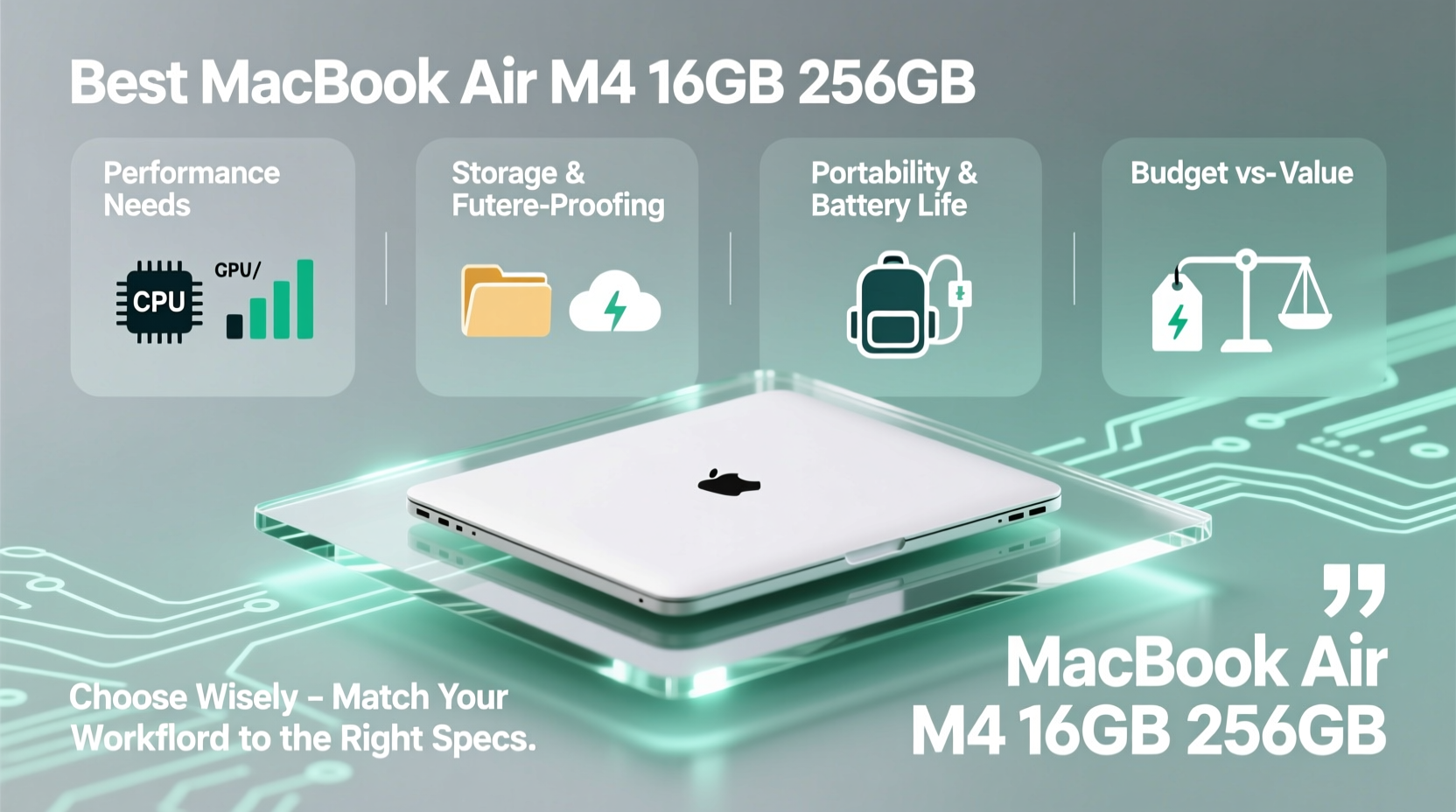
Storage is where your files, apps, and macOS live. Apple offers 256 GB to 8 TB options, depending on the model.
- 256 GB: Only for light users who store most files in the cloud.
- 512 GB: Good for most people. Enough for documents, photos, and a few large apps.
- 1 TB or more: For professionals, content creators, or anyone with lots of big files (videos, RAW images, local music libraries).
Example: A 4K video project can use up to 100 GB for one file. If you edit video, start at 1 TB or higher.
Graphics (gpu)
GPU is part of the chip in Apple Silicon. More GPU cores mean faster graphics, better video editing, and smoother gaming.
- M2/M3 base: 8–10 GPU cores. Fine for daily use and light creative work.
- M2/M3 Pro: More GPU cores (14–18). Great for photo/video editing.
- M2/M3 Max: Up to 38 GPU cores. For 3D rendering, serious video, or gaming.
Insider tip: The GPU you get depends on the chip you choose. For most, the base GPU is powerful enough.
Display
Screen size and quality affect your work and comfort. All MacBooks use Retina displays, but Pro models have higher brightness and better color.
- MacBook Air: 13.6″ or 15.3″, up to 500 nits brightness.
- MacBook Pro: 14.2″ or 16.2″, up to 1600 nits (XDR), higher refresh rate (120 Hz).
If you do graphic design or video editing, Pro screens are worth it for their color accuracy.
Battery Life
Apple Silicon chips are very efficient. Most MacBooks offer 12–18 hours of battery life for typical use.
- Air: Up to 18 hours (web, video playback)
- Pro 14″: Up to 18 hours (video playback)
- Pro 16″: Up to 22 hours (video playback)
Real-world tip: Video editing or running heavy apps will reduce battery life, sometimes by half.
Ports And Connectivity
Ports matter if you use external drives, monitors, or accessories.
- MacBook Air: 2 Thunderbolt/USB 4 ports, headphone jack.
- MacBook Pro 14″/16″: 3 Thunderbolt 4, HDMI, SD card, MagSafe charging, headphone jack.
If you need to plug in many devices, pick a Pro model or buy a USB-C hub.
How To Choose The Right Processor
Your choice of processor has the biggest impact on performance and price. Here’s how to decide.
M2 Vs M3 Chips
The M3 chip is the newest (late 2023), with faster performance and better efficiency than the M2. For most users, both are very fast. If you want the latest and best resale value, pick M3. But you can save money by choosing an M2 MacBook, especially if you find a deal.
Pro And Max Chips: Who Needs Them?
- M2/M3 Pro: Programmers, video editors, music producers, or those who run heavy apps.
- M2/M3 Max: Only needed for high-end video, 3D graphics, or scientific computing.
Non-obvious insight: If you only use Chrome, Microsoft Office, and Zoom, even the base M2/M3 is more power than you need.
Upgrading Within The Line
Some MacBooks let you pick between different versions of the same chip (e. g. , M2 with 8-core or 10-core GPU). The extra cost gives a small speed boost, but for most, the base chip is enough.
How Much Ram Do You Really Need?
RAM is a common place where buyers over- or under-spend. Here’s a practical guide.
- 8 GB: Fine for web, office, and light photo editing. Not enough for serious multitasking.
- 16 GB: The sweet spot for most users. Handles many browser tabs, big documents, and light creative work.
- 24 GB or more: Needed for video editing, large code projects, music production, or heavy multitasking.
Mistake to avoid: Picking minimum RAM to save money. macOS uses RAM aggressively, and not enough RAM can slow everything down. You can’t upgrade RAM later.
Choosing Storage: How Much Is Enough?
Storage is easy to underestimate. Here’s how to decide.
- 256 GB: Only choose if you use cloud storage (iCloud, Google Drive) for almost everything.
- 512 GB: Best for most users. Enough for documents, photos, and a few large apps.
- 1 TB: For people with lots of media (photos, music, videos) or large apps.
- 2 TB or more: Needed for video editors, musicians, or anyone with huge files.
Practical insight: macOS and default apps use 30–40 GB. Leave 20% free for best performance.
Pro tip: External SSDs are fast and affordable. If you need a lot of space for large files, you can save money by buying a smaller internal SSD and using external storage.
What About The Display?
The display affects your comfort and productivity more than you might think.
Screen Size
- 13.6″ Air: Most portable. Good for students, travelers.
- 15.3″ Air: Bigger, still light. Best for those who want more screen space but don’t need Pro power.
- 14.2″ Pro: Balance of portability and workspace.
- 16.2″ Pro: Largest. Best for creative work, multitasking, and those who don’t move their laptop much.
Display Quality
The ProMotion displays (on Pro models) offer up to 120 Hz refresh rate, making scrolling smooth. They are also brighter and support HDR, which is important for video and photo editors.
Practical insight: If you work outside or in bright rooms, the extra brightness on the Pro models can help.
Ports: What Do You Need?
Ports are often overlooked. Think about what you plug into your laptop.
- Air: 2 USB-C. You’ll need a hub for HDMI, SD card, or Ethernet.
- Pro: More ports, including HDMI and SD card reader.
Tip: If you do a lot of presentations or transfer photos from a camera, the extra ports on the Pro save time and hassle.
Credit: smartbuy.alibaba.com
Battery Life: Real-world Performance
Apple’s battery claims are accurate for light use (web, docs). If you do heavy work, expect less.
- MacBook Air: 14–18 hours (real-world: about 10–12 with mixed use)
- MacBook Pro 14″: 10–14 hours with typical use, less if you run heavy apps
- MacBook Pro 16″: Up to 16 hours with typical use, around 8–10 if you edit video
Non-obvious tip: The 16-inch Pro lasts longer than the 14-inch in light use, but heavy tasks (like video editing) drain both quickly.
Comparing Popular Configurations
Here’s a quick comparison of popular configurations for different users:
| Use Case | Model | CPU/GPU | RAM | Storage | Price (USD) |
|---|---|---|---|---|---|
| Student | MacBook Air 13.6″ | M2, 8-core | 8 GB | 256 GB | $1,099 |
| Office Worker | MacBook Air 15.3″ | M2, 10-core | 16 GB | 512 GB | $1,499 |
| Developer | MacBook Pro 14″ | M3 Pro, 11-core | 32 GB | 1 TB | $2,399 |
| Video Editor | MacBook Pro 16″ | M3 Max, 14-core | 64 GB | 2 TB | $3,899 |
Note: Prices are estimates and may change. Always check Apple’s website for current options.
Credit: www.intego.com
Saving Money Without Sacrificing Performance
Buying a MacBook is a big investment. Here’s how to get the most value:
- Don’t overbuy RAM or storage if you don’t need it.
- The base M2 or M3 is already very fast for most people.
- Buy refurbished from Apple: Same warranty, lower price.
- Consider student or education discounts if you qualify.
- Use external SSDs for large files instead of upgrading internal storage.
Non-obvious insight: Upgrading RAM and SSD at purchase costs more than buying a fast external SSD later. But RAM cannot be upgraded after purchase, so prioritize RAM if you must choose.
Common Buyer Mistakes To Avoid
- Underestimating RAM needs: 8 GB feels fast at first, but you may run out as apps get bigger.
- Choosing too little storage: MacOS grows with updates. Leave space for future files.
- Ignoring ports: If you use SD cards, HDMI, or many USB devices, the Air’s ports may frustrate you.
- Buying for today, not tomorrow: Choose specs that will last 3–5 years, not just for now.
- Assuming all MacBooks are the same: Pro models have better screens, speakers, and more power.
Future-proofing Your Macbook
A MacBook is an investment for several years. Here’s how to make sure your purchase lasts:
- Pick 16 GB RAM (or more) if you plan to keep your MacBook for 4–5 years.
- Choose at least 512 GB storage unless you’re sure you’ll use only cloud files.
- Get the latest chip if your budget allows. It will get software support longer.
- Buy AppleCare+ if you want extra peace of mind. MacBook repairs can be expensive.
Should You Wait For The Next Model?
Apple updates MacBooks every 1–2 years. If a new release is rumored soon (check tech news), it may be worth waiting. But if you need a MacBook now, today’s models are already very powerful.
Tip: Apple’s M-series chips are a big leap from Intel. If you use an old Intel MacBook, any M-series model will feel much faster.
Comparing Macbook Specs To Windows Laptops
MacBooks use Apple Silicon chips, which are different from Intel and AMD chips in Windows laptops. Here’s how they compare:
- Performance: M2 and M3 chips often beat Intel Core i7/i9 in real-world tasks, especially in battery life.
- RAM: 8 GB on Mac is closer to 12 GB on Windows, thanks to better memory management.
- Battery Life: MacBooks last longer on a single charge than most Windows laptops.
- Price: MacBooks are often pricier, but hold their value longer.
If you need special Windows apps, consider a Windows laptop. Otherwise, MacBooks offer better battery, build quality, and support.
For more technical details, you can visit the official Apple comparison page.
Final Checklist: Picking Your Macbook Specs
Before you buy, answer these questions:
- What will you use your MacBook for most?
- Do you need a portable model or a desktop replacement?
- How many apps/tabs do you keep open at once?
- Will you edit large photos or videos?
- How much storage do you use today? Will it grow?
- Do you need special ports for devices?
- What is your budget?

Credit: www.wired.com
Making The Purchase: Where And How
You can buy a MacBook from:
- Apple Store: Best for custom specs, student discounts, and support.
- Refurbished Apple Store: Save money, full warranty.
- Authorized resellers: Sometimes offer discounts or bundles.
- Third-party sellers: Always check for warranty and return policy.
Pro tip: If you buy from Apple, you can return the MacBook within 14 days for any reason.
Frequently Asked Questions
What Is The Best Macbook For Students?
The MacBook Air 13.6-inch with 8 GB RAM and 256 GB storage is enough for most students. If you need more screen space, the 15.3-inch Air is a good option. For coding or media projects, consider 16 GB RAM.
Can I Upgrade Ram Or Storage After Buying?
No. Apple solders RAM and storage onto the motherboard in all new MacBooks. Choose enough RAM and storage when you buy.
Is 8 Gb Ram Enough For Macbook In 2024?
For web, email, and office work, 8 GB is okay. For multitasking, programming, or creative work, 16 GB is much better and more future-proof.
Which Macbook Is Best For Video Editing?
The MacBook Pro 14-inch or 16-inch with M2/M3 Pro or Max chip, at least 32 GB RAM, and 1 TB storage is ideal for video editing. The larger screen and better GPU help with editing speed and color accuracy.
Does The Macbook Air Overheat With Heavy Use?
The Air has no fan, so it can get warm during heavy tasks like video editing. It slows down (throttles) to keep cool. For demanding work, the MacBook Pro is better because it has fans and stays fast.
Choosing the right MacBook specs is about knowing your needs today and tomorrow. If you balance RAM, storage, and chip for your work, you’ll have a laptop that serves you well for years—without overpaying for things you’ll never use. Take your time, ask questions, and enjoy your new MacBook.
 MacBook Gear